
Thrustmaster T300 RS, T248, TX, T150 and TMX on Linux
Thrustmaster wheels need a driver of their own on Linux for force feedback. SimRig installs the right one and sets rotation and force feedback.
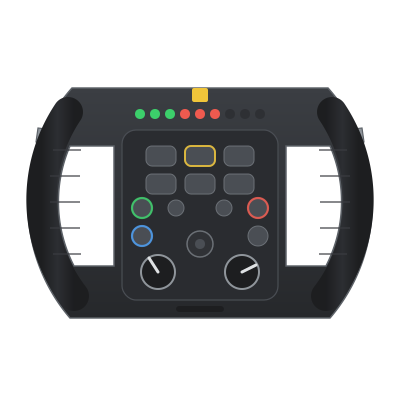
- Steering wheel
- Thrustmaster
- Driver
- hid-tmff2 or hid-t150, built with DKMS
- Tested on hardware
- Not yet
Untested on real hardware. These models work in SimRig's tests on simulated devices; nobody has tried them on the real thing yet.
Have one? Try it and tell how it went: about 15 minutes, and it moves your model to tested for everyone.
Models
| Models | Force feedback | Driver |
|---|---|---|
| T300 RS, T-GT II, T248, T128, TX, TS-PC Racer, TS-XW | Yes | hid-tmff2 |
| T150, TMX | Yes | hid-t150 |
| T500 RS | No: no Linux driver drives it yet; inputs only | in the kernel |
| T80, T80 (H) | The wheel has none; inputs only | in the kernel |
The pedals on the base come with the wheel. The T818 is not supported.
Drivers
- hid-tmff2, by Kim Kuparinen and contributors, with hid-tminit, which starts the wheel up in its PC mode. SimRig builds it with DKMS and keeps the kernel’s own Thrustmaster driver out of its way.
- hid-t150, by Dario Pagani, built only when a T150 or TMX is plugged in.
The Xbox editions are taken back from the gamepad driver, so they are seen as wheels. If you installed one of these drivers yourself, SimRig uses yours as it is.
What you can set
- Rotation, up to 1080° (900° on some models), and force feedback strength.
- The centering spring, the strength of the games’ friction effects, and of their spring and damper effects (hid-tmff2 wheels).
- Test force feedback, to check the wheel before opening a game.
Saved settings become the driver’s start-up options, so they come back with SimRig closed.
Limits
- The TMX must already be in its PC mode: hid-tminit does not start it up.
- The driver does not say which rim is mounted, and buttons are shown by number.
- The T500 RS keeps its own rotation, 1080°; the T80 is fixed at 270°.
- Wheels center themselves when plugged in.
Other tools
Oversteer works with the same drivers for rotation and force feedback. See other Linux tools.
Set it up
- Install SimRig from the package for your distribution (Debian, Ubuntu, Fedora, openSUSE, Arch and others).
- Open SimRig, plug the device in and choose Add device. A known model is recognized by itself; a USB shifter or handbrake that no plugin knows is set up by moving it.
- If the device needs a driver, SimRig installs it: it asks for your password once and says why. With Secure Boot on, it may ask for one restart to enroll the drivers' signing key.
- The device appears on the rig and moves live. Its settings apply at once; Save as default keeps them for every time it is plugged in.
From then on the device works in every game, with SimRig closed. If it works in SimRig but not in a game, SimRig checks why (access, kernel driver, Steam Input) and says how to fix it: see the FAQ.